Patent Process Overview
The US patent process is a structured series of steps that transforms your invention from an idea into a legally enforceable property right. While the process can feel complex from the outside, it follows a clear path that an experienced patent attorney can guide you through efficiently.
Having secured an extensive portfolio of US patents over more than a decade of patent prosecution, I have guided inventors through every variation of this process — from straightforward mechanical devices that sail through examination to complex software systems that require multiple rounds of prosecution. Here is a comprehensive overview of what to expect at each stage.
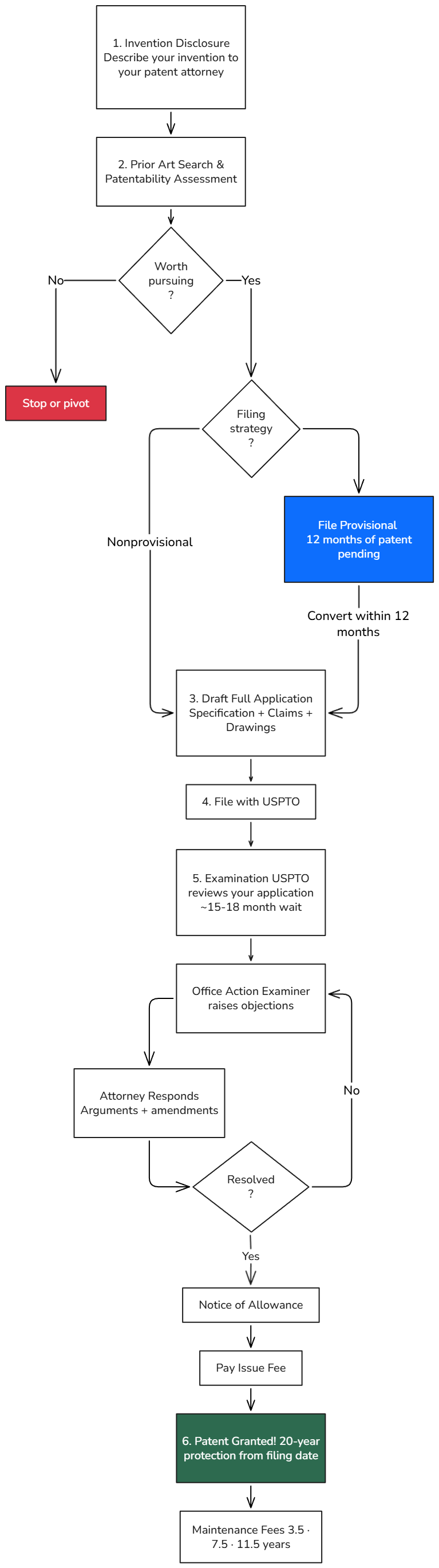
Process at a Glance
Stage 1: Invention Disclosure
The process begins when you share the details of your invention with your patent attorney. This initial consultation is one of the most important steps because it shapes everything that follows.
What you should be prepared to discuss:
- How the invention works — the mechanics, electronics, software, chemistry, or whatever makes it function
- What problem it solves — the specific pain point or need that your invention addresses
- What makes it different from existing products or methods — your invention’s “secret sauce”
- Potential applications — where and how the invention could be used, including applications you may not have originally considered
- Stage of development — whether you have a working prototype, a conceptual design, computer simulations, or just a detailed idea
The invention disclosure conversation typically lasts one to two hours, and your attorney may follow up with additional questions as they develop a deeper understanding of the technology. The more thoroughly you can describe your invention, the stronger your eventual patent application will be.
When the inventor behind the Acoustic Isolation Booth first described the concept, the disclosure conversation revealed applications in both construction environments and medical settings. By capturing both use cases in the application, we secured broader protection than the inventor originally anticipated.
A good patent attorney uses this stage to begin thinking strategically about how to position your claims for the strongest possible protection.
Stage 2: Prior Art Search and Patentability Assessment
Before investing in a full patent application, your attorney conducts a prior art search — a comprehensive review of existing patents, published applications, academic papers, industry publications, and other publicly available information in your technology area.
Why the prior art search matters:
The search answers three critical questions:
- Is your invention novel? Has anyone patented or published something identical or very similar?
- Is it non-obvious? Would someone skilled in the field consider your invention an obvious combination of existing ideas?
- How broad can your patent be? How much of the design space around your invention is already taken up by prior art?
Your attorney reviews the search results and provides a written patentability opinion. This opinion is not just a yes-or-no answer — it is a strategic assessment that identifies:
- The strongest aspects of your invention from a patentability standpoint
- Potential prior art challenges and how to address them in the application
- Recommendations for how to focus your claims to maximize protection
Sometimes the search reveals that the core concept already exists, but a specific improvement, combination, or application is still patentable. For instance, when searching prior art for the Tool Safety System, existing safety devices were found in abundance, but the integration of digital tracking technology was a novel contribution that became the foundation of the patent strategy.
The patentability assessment is also the point where I give you an honest evaluation of whether pursuing a patent makes sense for your situation. Not every invention is patentable, and not every patentable invention justifies the investment. I would rather save you money upfront than lead you into a process that is unlikely to succeed.
Stage 3: Application Preparation
Once you decide to move forward, your attorney drafts the complete patent application. This is the most labor-intensive stage and typically takes four to eight weeks depending on the complexity of the invention.
A patent application consists of several key components:
Specification
The specification is the written description of your invention. It must meet the USPTO’s “enablement” requirement — meaning it must describe the invention in enough detail that a person skilled in the relevant field could make and use it without undue experimentation. The specification includes:
- Background of the invention: What problem exists and how current solutions fall short
- Summary of the invention: A high-level description of your invention and its advantages
- Detailed description of preferred embodiments: A thorough walkthrough of how the invention is constructed and how it operates, often with reference to the drawings
- Alternative embodiments: Variations of the invention that broaden the scope of disclosure
Claims
The claims are the legal boundaries of your patent — they define exactly what you own. Claim drafting is where legal skill and technical knowledge intersect most critically.
A well-drafted set of claims includes:
- Independent claims that capture the broadest version of the invention
- Dependent claims that add specific features, creating fallback positions if the broadest claims face challenges
- Method claims describing the process of using the invention (when applicable)
- System or apparatus claims describing the physical structure
When drafting claims for the Hydrogen Hybrid Cycle System, the claims needed to cover both the physical components of the energy system and the novel process by which it operated. Multiple claim types ensured comprehensive protection.
Drawings
Patent drawings must meet strict USPTO formatting requirements and accurately illustrate every feature described in the specification and claims. Depending on the invention, drawings may include:
- Multiple perspective views (front, side, top, bottom)
- Cross-sectional views showing internal components
- Exploded views showing how parts fit together
- Flowcharts for processes and software-related inventions
- Block diagrams for system architectures
The Endoscope Instrumentation Drive System required detailed cross-sectional drawings of the precision drive mechanism alongside system-level diagrams showing how the components interacted during endoscopic procedures.
Abstract
A brief paragraph (150 words or less) summarizing the invention for search and classification purposes.
Stage 4: Filing with the USPTO
Once the application is complete and you have reviewed and approved it, your attorney files it with the United States Patent and Trademark Office.
You have two filing options:
Provisional Patent Application
A provisional application establishes an early filing date at a lower cost and gives you 12 months to refine the invention, test the market, or seek funding before committing to a full examination. Key characteristics:
- Lower filing fees (approximately $80 for micro entities as of 2026)
- Allows you to use “patent pending” status immediately
- Does not get examined — it simply preserves your filing date
- Must be followed by a non-provisional application within 12 months
- Does not start the 20-year patent term clock
Non-Provisional Patent Application
The full application that enters the examination queue. Key characteristics:
- Higher filing fees (see our patent cost guide for details)
- Gets assigned to a USPTO examiner for substantive review
- Starts the 20-year patent term clock from the filing date
- Published 18 months after the earliest filing date (unless you opt out of publication for applications filed only in the US)
Many inventors start with a provisional and convert to a non-provisional within the 12-month window. This approach was used for several patents in our portfolio, including the Automatic Gin Blade Trainer, where the provisional period allowed the inventor to refine the agricultural automation technology before the full application was filed.
Stage 5: USPTO Examination
After filing a non-provisional application, your application enters the USPTO examination queue. As of 2026, the average wait for a first office action is approximately 15 to 18 months, though this varies significantly by technology area. Some art units (the USPTO’s term for technology-specific examiner groups) have shorter backlogs than others.
What happens during examination:
-
Assignment: The USPTO assigns your application to an examiner who specializes in your technology area based on the classification of your invention.
-
Examiner’s search: The examiner conducts their own prior art search, looking for patents, publications, and other references that might anticipate or render obvious your claimed invention.
-
First office action: In most cases, the examiner issues a first office action raising rejections or objections to some or all of your claims. Common types include:
- Anticipation rejections (35 USC 102): A single prior art reference discloses every element of your claim.
- Obviousness rejections (35 USC 103): A combination of prior art references makes your claim obvious to someone skilled in the field.
- Indefiniteness rejections (35 USC 112): The claim language is unclear or ambiguous.
- Restriction requirements: The application covers multiple distinct inventions and you must choose which to pursue first (the others can be filed as divisional applications).
-
Response: Your attorney reviews the office action, discusses strategy with you, and prepares a formal response. This may include legal arguments, claim amendments, or both.
-
Subsequent office actions: The examiner reviews your response and may issue additional office actions. Most applications reach a resolution within two to three rounds of office actions.
-
Allowance: When the examiner is satisfied that your claims are patentable, they issue a notice of allowance.
Strategies for efficient prosecution:
- Examiner interviews: Your attorney can request a phone or video conference with the examiner to discuss the issues directly. These interviews are often more productive than written exchanges alone.
- Track One prioritized examination: For an additional fee, the USPTO offers expedited examination with a goal of reaching a final disposition within 12 months. This is valuable when speed matters — for example, when you need an issued patent to support licensing negotiations or investor discussions.
- After-final practice: If a final rejection is issued, several options remain, including filing a request for continued examination (RCE), filing a continuation application, or appealing to the Patent Trial and Appeal Board.
Stage 6: Patent Grant and Post-Grant
Once your claims are allowed and you pay the issue fee, the USPTO grants your patent. The patent document is published and added to the public record.
What your granted patent provides:
- The legal right to exclude others from making, using, selling, offering for sale, or importing your invention in the United States for 20 years from the filing date (for utility patents) or 15 years from the grant date (for design patents)
- A property right that can be licensed, sold, assigned, or used as collateral
- The foundation for enforcement against infringers
- “Patent No. XXXXXXX” marking on your products, replacing “patent pending”
Post-grant responsibilities:
- Maintenance fees are due at 3.5, 7.5, and 11.5 years after the grant date for utility patents. Missing these deadlines can cause your patent to expire early. See our cost guide for fee amounts.
- Continuation applications can be filed to pursue additional claims based on the same disclosure, expanding your protection.
- Enforcement — monitoring the market and taking action against infringers to protect your rights.
Timeline Summary
Here is a realistic timeline for the patent process as of 2026:
| Stage | Typical Duration |
|---|---|
| Invention disclosure and search | 2 - 4 weeks |
| Application drafting | 4 - 8 weeks |
| USPTO examination queue | 12 - 18 months |
| Prosecution (office actions and responses) | 6 - 18 months |
| Total from disclosure to grant | 2 - 3 years |
These timelines can vary. Simple mechanical inventions in uncrowded art areas may be granted in under 2 years. Complex software or biotechnology applications in congested art units may take 3 to 4 years or more. Track One prioritized examination can compress the post-filing timeline to under 12 months.
Real Examples from Our Portfolio
These patents illustrate the range of inventions that have successfully navigated the process:
- Rope Cleaner — Agricultural tool, straightforward mechanical prosecution
- Saw Gin Stand Safety Assembly — Industrial safety equipment with specialized cotton ginning applications
- Oilfield Chemical Injection System — Oil and gas technology requiring industry-specific prior art analysis
- Bandsaw Automated Portioning Saw System — Complex automation with visual processing components
- Gun Lock — Consumer product with software and mechanical elements
Browse the full Innovation Showcase to see more examples of successfully granted patents across all technology areas.
Frequently Asked Questions
How long does a patent last? Utility patents last 20 years from the filing date, provided maintenance fees are paid on schedule. Design patents last 15 years from the grant date with no maintenance fees required. Plant patents last 20 years from the filing date. Learn more in our Types of Patents guide.
Can I sell my product while the patent is pending? Yes. Once your application is filed, you can mark your product as “patent pending,” which provides notice to the public and potential competitors. However, you cannot enforce patent rights until the patent is actually granted. If someone copies your invention during the pending period, you may be entitled to provisional rights (reasonable royalties) from the date the application was published.
What happens if my patent application is rejected? A rejection does not mean the process is over. Most applications receive at least one rejection, and most of those are successfully overcome through claim amendments and legal arguments. If the examiner maintains a final rejection, you have options including filing a request for continued examination (RCE), filing a continuation application, or appealing to the PTAB.
Do I need a working prototype to file a patent? No. The USPTO does not require a working prototype. You need a description detailed enough that someone skilled in the field could make and use the invention, but that description can be based on conceptual designs, CAD drawings, or theoretical models. That said, if you have a prototype, it often makes the application stronger by providing concrete details.
What is the difference between “patent pending” and “patented”? “Patent pending” means an application has been filed but not yet granted. It provides notice to competitors but no enforceable rights. “Patented” means the patent has been granted and is enforceable — the patent holder can take legal action against infringers. Learn more about what happens at each stage from a patent attorney’s perspective.
Disclaimer: All fees and cost estimates on this page are for informational purposes only and do not constitute a binding quote. Actual costs vary based on the complexity of the invention, USPTO fee schedules, exchange rates, and other factors. Contact Shannon Warren for a specific estimate tailored to your situation.
Ready to start the patent process? Shannon Warren has guided numerous inventions through this process, with offices in Houston and Amarillo serving inventors across Texas. Contact Shannon Warren to begin your patent journey.